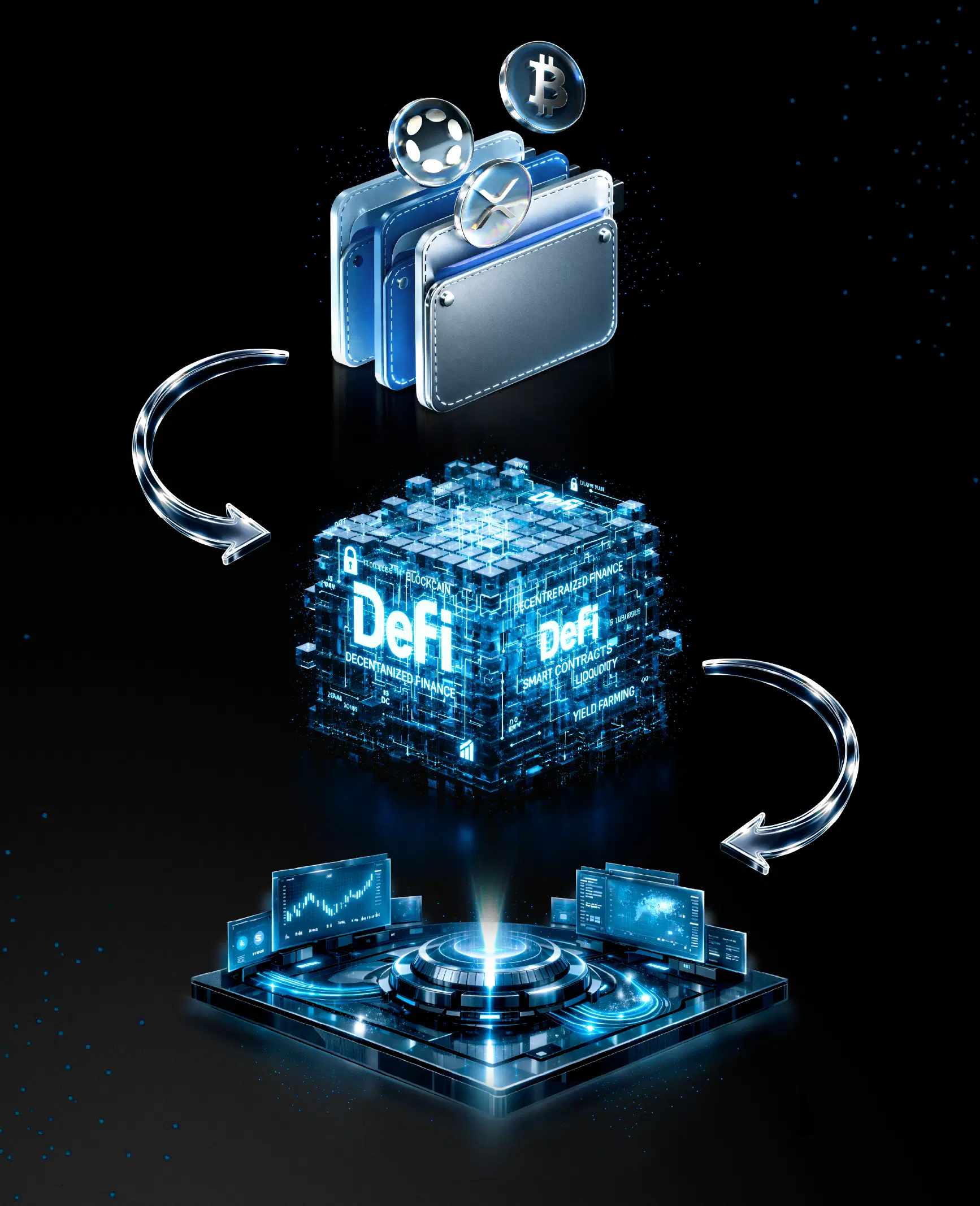
RVA DeFi brings liquidity, yield strategies and tokenised assets onto SmartChain with the same discipline that powers Wallet, Exchange and Launchpad. It is designed so capital can move across Web3 rails transparently, without losing sight of risk, provenance or control.
Built on SmartChain · Designed for serious capital

SmartChain enables fast settlement, allowing assets to move smoothly between trading, liquidity pools, staking and tokenised positions. The framework aims to route liquidity efficiently instead of fragmenting it across isolated contracts.
Yield comes from on-chain mechanisms such as staking emissions, swap fees and lending interest, not from opaque promises. RVA surfaces where yield originates and how sustainable it appears over time.
DeFi carries real risk. RVA emphasises reviewed code, clear documentation, position visibility and governance controls that can pause or adapt strategies when conditions change.
DeFi on RVA sits between user wallets and the broader exchange environment:
This architecture lets both retail and professional users see DeFi activity in the same environment as their centralised balances, without jumping between disconnected tabs.
(Transactions · Liquidity · Rewards)
Automated market makers and routing contracts enable permissionless swaps. Liquidity providers earn fees proportional to the share and strategy they supply.
Users can supply assets and earn interest or borrow against their holdings with clear collateral ratios. Health factors and liquidation thresholds are always visible.
Staking contracts and yield strategies connect to consensus rewards or protocol fees. Yields are shown with estimated rates, lock or unbonding periods and the underlying mechanism that generates returns.
SmartChain can represent exposures such as real estate, funds or revenue streams through tokenised structures with clear legal mappings and on-chain distribution.
Where possible, protocols rely on reviewed and audited contracts. Upgrade paths, admin functions and dependency chains are documented to reduce unexpected behaviour.
Users should always be able to see where their assets sit, how positions are structured and how rewards are calculated. Dashboards aim to make flows understandable rather than opaque.
Higher-risk structures, such as leverage or complex derivatives, follow stricter access and disclosure expectations. The framework separates core DeFi plumbing from experimental ideas so users can choose their risk intentionally.
On RVA SmartChain it is treated as infrastructure, not hype: transparent flows, disciplined engineering and a long-term approach to Trust, Transparency and the Future of programmable finance.